

Democracy and conflict
The end of Rana rule, a first elected government, three decades of the partyless Panchayat system, the 1990 People's Movement, a decade of Maoist insurgency and the 2006 peace accord.
- 16 events
- 1950 – 2006
- The whole timeline
Democracy and conflict
The end of Rana rule, a first elected government, three decades of the partyless Panchayat system, the 1990 People's Movement, a decade of Maoist insurgency and the 2006 peace accord.
- 19502007 BSNovember 1950 – February 1951
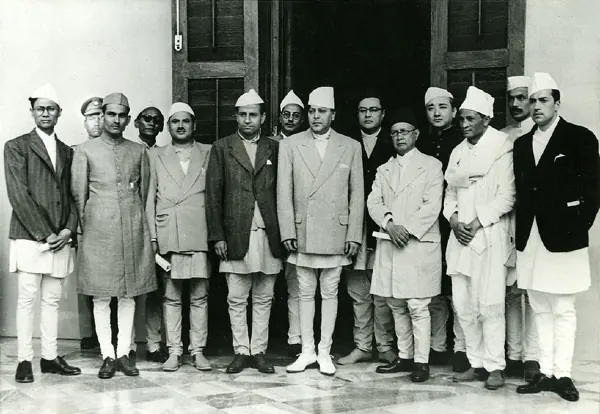
Revolution ends 104 years of Rana rule
On 6 November 1950 King Tribhuvan left the palace and took refuge in the Indian embassy in Kathmandu, and was flown to Delhi.
Read more
On the night of 10 to 11 November the Nepali Congress launched an armed uprising from Indian territory, its Mukti Sena taking Birgunj and fighting in the eastern and western Terai. The Rana government, isolated and facing an Indian government unwilling to prop it up, entered negotiations in Delhi with the King and the Congress. The resulting tripartite settlement, usually called the Delhi Agreement, returned Tribhuvan as head of state and provided for a coalition cabinet and an eventual constituent assembly. He flew back to Kathmandu on 15 February 1951 and proclaimed the end of the Rana regime on 18 February. The settlement remains contested: some see it as the founding act of Nepali democracy, others as a compromise that preserved Rana and palace power and gave India lasting leverage. The promised constituent assembly was never convened.
- 19532010 BS29 May 1953
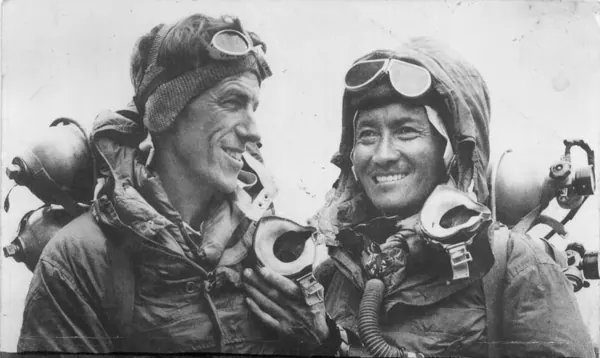
First ascent of Sagarmatha
At about half past eleven on the morning of 29 May 1953, Tenzing Norgay and Edmund Hillary stood on the summit of the world's highest mountain, known in Nepali as Sagarmatha and in Tibetan as Chomolungma.
Read more
They were part of a British expedition led by Colonel John Hunt, which approached from the Nepali side through the Khumbu Icefall and the Western Cwm — a route possible only because Nepal had opened its northern valleys to foreign expeditions after 1949. Tenzing, a Sherpa raised in the Khumbu and long resident in Darjeeling, had already made several attempts on the mountain. News reached London on 2 June, the morning of Queen Elizabeth II's coronation, and the climb became a global story; the two men always declined to say who stepped up first, describing it as a joint effort. Nepal had begun issuing tourist visas and receiving its first organised tourist parties by 1955, and mountaineering and trekking grew into one of the country's largest industries.
- 19552012 BS14 December 1955
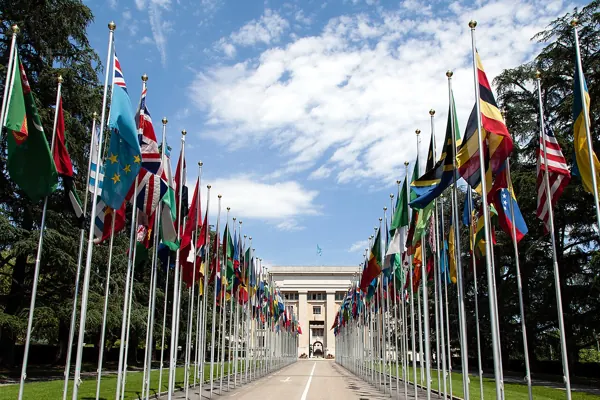
Nepal joins the United Nations
Nepal became the eightieth member of the United Nations on 14 December 1955.
Read more
It had first applied in 1949, while still under Rana rule, but the application was blocked in the Security Council by a Soviet veto amid the deadlock of the early Cold War, in which each bloc obstructed applicants associated with the other. The impasse was broken by a package deal that admitted sixteen states at once, among them Nepal, Sri Lanka, Ireland, Italy, Jordan, Libya, Cambodia and Laos. Membership mattered a great deal to a small landlocked state wedged between India and China: it gave Nepal a seat and a voice in a forum where its formal equality with its neighbours was recognised, and it anchored the non-aligned foreign policy pursued by King Mahendra and his successors. Nepal has since become one of the world's largest contributors of troops and police to UN peacekeeping, and the UN played a direct role in monitoring Nepal's own peace process after 2006.
- 19592015 BSFebruary – May 1959
Nepal's first elected government
The constituent assembly promised in 1951 was never convened.
Read more
Instead King Mahendra, who had succeeded Tribhuvan in 1955, promulgated a constitution in February 1959 providing for a parliament under the Crown, and ordered a general election. Voting ran from 18 February to 3 April, staggered across the country because of the difficulty of moving ballot boxes through the hills; most voters could not read, and parties were identified by symbols. The Nepali Congress won 74 of the 109 seats on about 38 per cent of the vote, and B. P. Koirala was sworn in on 27 May 1959 as Nepal's first elected prime minister. His government moved quickly on land reform, the abolition of birta landholdings, taxation of large estates and the reorganisation of local administration — measures that won support among tenants but alienated landowners, sections of the aristocracy and the palace. The constitution reserved substantial emergency powers to the King, a tension resolved within eighteen months.
- 19602017 BS15 December 1960
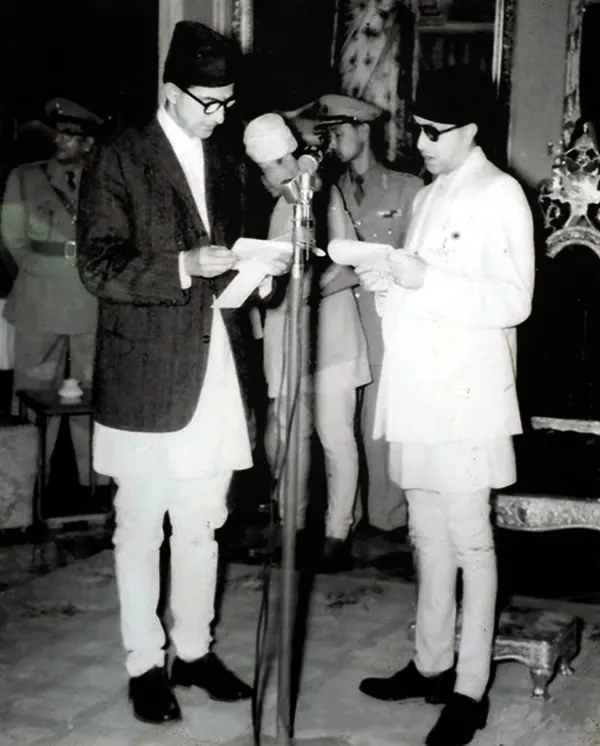
The King dismisses the elected government
On 15 December 1960, eighteen months after the election, King Mahendra used the emergency powers in his own constitution to dismiss the Nepali Congress government, dissolve parliament, suspend the constitution and ban political parties.
Read more
Prime Minister B. P. Koirala, his cabinet colleagues and hundreds of party workers were arrested; Koirala was held without trial until 1968 and then went into exile in Banaras, returning voluntarily in 1976 under his policy of national reconciliation and dying in Kathmandu in 1982. The King justified the takeover by charging the government with corruption, incompetence and failing to safeguard national unity. His critics then and since have argued that the real motive was the threat an organised mass party and its land reforms posed to the monarchy, and that Mahendra also feared the drift of Nepali politics towards India. It remains one of the most disputed moments in modern Nepali history — read by some as a rescue of national stability, by others as the theft of a democratic mandate.
- 19622019 BS1962 – 1990
The partyless Panchayat system
King Mahendra introduced the Panchayat system in January 1961 and entrenched it in a new constitution promulgated on 16 December 1962. Political parties were banned outright.
Read more
In their place stood a pyramid of assemblies, from village and town panchayats through district bodies up to the national Rastriya Panchayat, with members at each level chosen largely by those below rather than directly by voters. It was presented as a guided democracy rooted in Nepali tradition and suited to a poor, largely rural country, with the King as active head of government and power exercised through the palace secretariat. Its defenders point to road building, the expansion of schooling, the growth of a national administration and a period of relative stability. Its critics point to censorship, the jailing and exile of opponents, the concentration of patronage around the palace, and the exclusion of most Nepalis from real decisions. Direct elections to the national body came only after 1980. The system was dissolved by royal proclamation on 17 April 1990.
- 19792035/36 BS1979
UNESCO lists the Kathmandu Valley as World Heritage
In 1979 UNESCO inscribed the Kathmandu Valley on the World Heritage List.
Read more
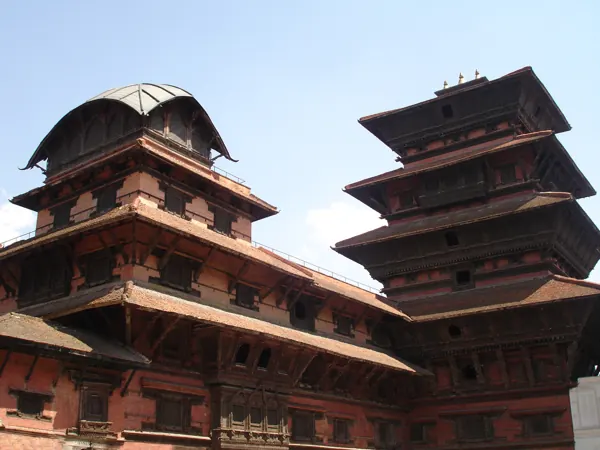
The listing covers seven monument zones: the Durbar Squares of Kathmandu, Patan and Bhaktapur, the Buddhist stupas of Swayambhunath and Boudhanath, and the Hindu temples of Pashupatinath and Changu Narayan. The boundaries were revised in 2006.
Much of what it protects was built or rebuilt under the Malla kings: the palaces and temples of the three Durbar Squares, the Krishna Mandir, the Nyatapola and the Kumari Ghar. Kasthamandap, the wooden pavilion in Kathmandu Durbar Square whose name means "wood-covered shelter", is traditionally dated to 1596 under Lakshmi Narasimha Malla, though excavations after 2015 dated its oldest parts to the seventh century.
From 2003 to 2007 the valley was on UNESCO's list of World Heritage in Danger, over concerns that the monument zones were losing their authentic character. The April 2015 earthquake severely damaged all three Durbar Squares: the Hari Shankar temple in Patan collapsed and Kasthamandap was reduced to rubble.
- 19802037 BS2 May 1980
The referendum on the Panchayat system
Student protests that began in April 1979 over the execution of Pakistan's Zulfikar Ali Bhutto turned rapidly into a domestic agitation, spreading to around half of Nepal's districts; official figures recorded eleven dead and 164 injured.
Read more
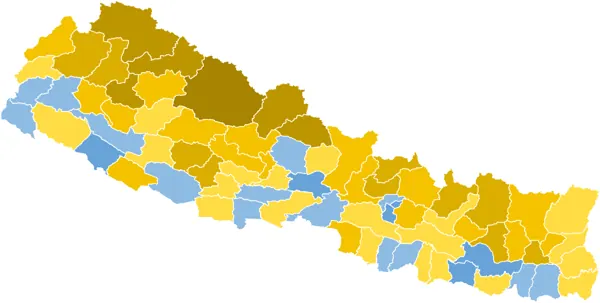
Facing unrest the security forces could not easily contain, King Birendra announced a national referendum. On 2 May 1980 Nepalis voted in the first such poll in the country's history, choosing between the partyless Panchayat system with reforms and a multiparty system, marking yellow or blue on the ballot. Turnout was 66.9 per cent. The Panchayat option won with 54.9 per cent against 45.1 — a margin of under ten points. Parties remained formally banned but had campaigned openly, and the closeness of the result showed how substantial opposition sentiment had become. Opposition leaders alleged irregularities and misuse of state resources; supporters pointed to the turnout and to the fact that a losing side had been allowed to campaign at all.
- 19892045 BS1989 – 1990
India closes the border
Nepal's trade and transit treaties with India expired on 23 March 1989 and were not renewed. India closed thirteen of the fifteen agreed transit points, leaving a landlocked country with almost no route for imports.
Read more
Petrol, diesel, kerosene, salt, medicines and industrial inputs ran short within weeks; queues, rationing, factory closures and inflation followed, felt hardest by the urban poor and by hill districts at the end of long supply lines. The stated dispute was technical — India wanted a single combined treaty, Nepal insisted on separate trade and transit agreements as a matter of sovereign right. Behind it lay India's anger at Nepal's purchase of Chinese anti-aircraft weapons in 1988, a work-permit system applied to Indian nationals, and a wider deterioration in relations between Delhi and the palace. Nepali accounts generally call it a blockade; Indian officials rejected the term. The hardship discredited the Panchayat government and helped create the conditions for the movement of 1990.
- 19902046/47 BS1990s onwards
Foreign employment reshapes Nepal
Nepalis have long worked abroad — in Indian cities, in the Gurkha regiments, in the tea gardens of Darjeeling. From the 1990s the scale and direction changed.
Read more
Rules were liberalised, air links improved and recruitment agencies multiplied, and hundreds of thousands began leaving each year for Malaysia, Qatar, Saudi Arabia, the UAE and Kuwait, alongside the continuing open-border movement into India and smaller flows to Britain, Japan, Korea and Australia. Remittances grew from a marginal item into the mainstay of the economy, reaching roughly 6.7 billion US dollars by 2015 and around a quarter of national income by the 2020s, among the highest shares in the world. That money paid for food, housing, schooling and healthcare and cut measured poverty sharply. The cost has been heavy: workers routinely borrowed at high interest to pay recruitment fees, arrived to find contracts substituted, and worked in extreme heat with limited protection. Deaths abroad became a recurring subject of parliamentary and press scrutiny, and long separations reshaped families and left villages with few working-age adults.
- 19902046 BS1990
People's Movement I ends absolute monarchy
The Jana Andolan of 1990 brought the Panchayat system down.
Read more
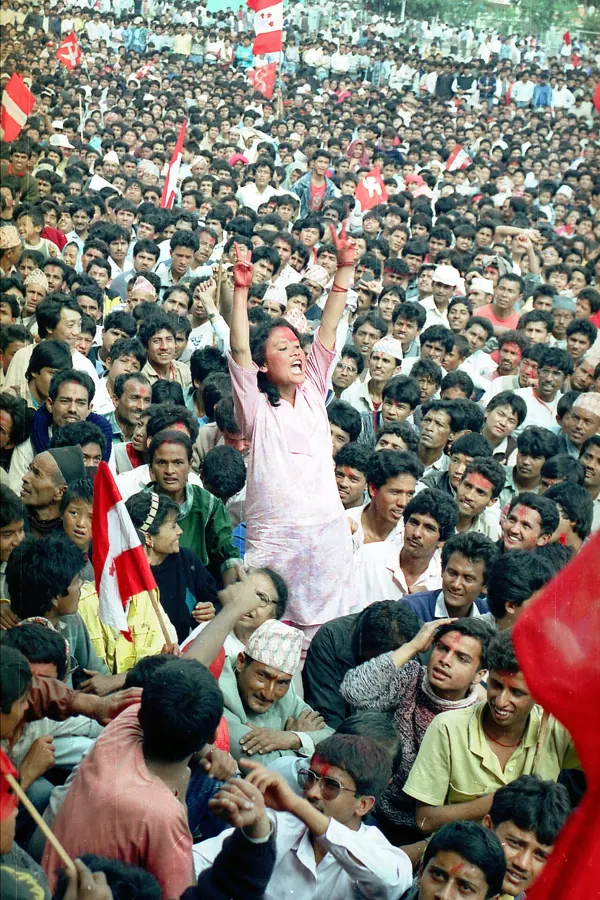
Its distinguishing feature was unity: the Nepali Congress and the communist parties, grouped in the United Left Front, campaigned together, and the alliance produced both the movement's strength and, later, the Communist Party of Nepal (Unified Marxist-Leninist). Mass demonstrations, strikes and a security crackdown that killed dozens ran through February to April, and on 17 April King Birendra lifted the ban on political parties and dissolved the Panchayat system. A constitution promulgated on 9 November 1990 vested sovereignty in the people for the first time, guaranteed fundamental rights and made ministers answerable to an elected House of Representatives, while leaving the King as head of state, supreme commander of the army and holder of significant reserve powers. It also defined Nepal as a Hindu kingdom and did little for regional, ethnic and linguistic minorities. Those omissions became central grievances in the decades that followed. Nepal's first multiparty election in 32 years was held on 12 May 1991.
- 19962052 BS1996 – 2006
The Maoist insurgency and civil war
On 13 February 1996 the Communist Party of Nepal (Maoist) launched an armed insurgency with the stated aim of overthrowing the monarchy and establishing a people's republic.
Read more
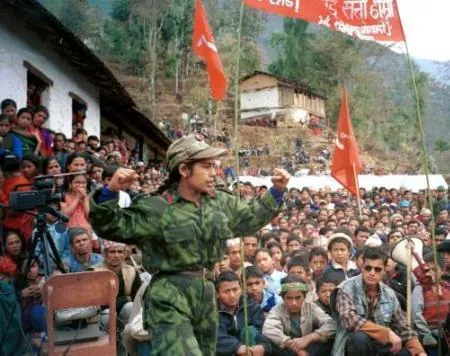
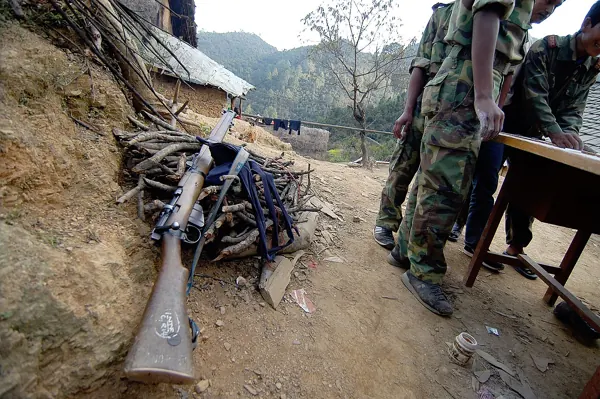
It began with attacks on police posts in Rolpa, Rukum and Sindhuli and spread over a decade into most of the country, drawing on real grievances — landlessness, caste and regional exclusion, the failure of the 1990 settlement to reach rural Nepal — and prosecuted through guerrilla warfare, parallel administration and, at times, extortion and abduction. The state's response, particularly after the army was deployed in 2001, involved mass detentions, disappearances and extrajudicial killings. The UN human rights office records at least 13,000 people killed and around 1,300 missing; some Nepali tallies put the dead nearer 17,000. Serious abuses were committed by both sides, and accountability for them remains largely unfinished. The war ended with the Comprehensive Peace Accord of 21 November 2006, and transformed Nepali politics: the Maoists entered mainstream politics and the monarchy did not survive.
- 20012058 BS1 June 2001
The royal palace massacre
On the evening of 1 June 2001, during a family gathering at Narayanhiti Palace, nine members of Nepal's royal family were shot dead, among them King Birendra, Queen Aishwarya, Prince Nirajan and Princess Shruti.
Read more
A government-appointed inquiry led by the chief justice and the speaker named Crown Prince Dipendra as the gunman, reporting that he had been drinking and had quarrelled with his family over his choice of bride, and that he then shot himself; he died three days later, having been proclaimed king while unconscious. Gyanendra, Birendra's brother, took the throne. The inquiry's account is accepted by many and disbelieved by many others: the speed of the investigation, the absence of a full post-mortem examination and the fact that Gyanendra and his immediate family were not present that night fed conspiracy theories that have never gone away. Whatever happened in the palace, the massacre destroyed the personal standing the monarchy had rebuilt since 1990, and its consequences ran directly into the crisis of 2005.
- 20052061 BSFebruary 2005 – April 2006
King Gyanendra takes direct power
On 1 February 2005 King Gyanendra dismissed the government of Sher Bahadur Deuba, assumed executive power himself and declared a state of emergency, saying the parties had failed to hold elections or end the insurgency and promising to restore peace and multiparty democracy within three years.
Read more
Fundamental rights were suspended, soldiers were posted in newsrooms, telephone and internet links were cut for days, and politicians and journalists were detained or placed under house arrest. India, the United Kingdom and the United States condemned the takeover and suspended military assistance. Rather than isolating the Maoists, it pushed the mainstream parties towards them: in November 2005 the seven parliamentary parties and the CPN (Maoist) signed a twelve-point understanding in Delhi to end both the insurgency and absolute monarchy. It is generally seen as the decisive miscalculation that ended the Nepali monarchy, though views on Gyanendra's motives remain sharply divided.
- 20062062 BSApril 2006
People's Movement II
The Loktantra Andolan of April 2006 was a nationwide general strike and mass mobilisation against King Gyanendra's direct rule, organised by the seven-party alliance with Maoist support under the twelve-point understanding.
Read more
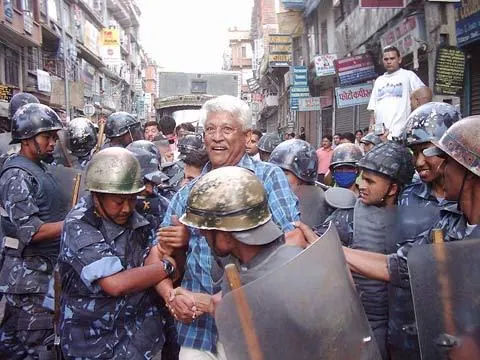
Curfews were imposed and defied; hundreds of thousands marched on the Kathmandu ring road; the security forces killed around nineteen people and injured thousands. Prominent leaders, including the Nepali Congress spokesman Arjun Narsingh K.C., were arrested. After nineteen days the King announced on 24 April that he was reinstating the House of Representatives dissolved in 2002. Parliament met on 28 April, stripped the monarchy of its remaining powers in May, brought the army under civilian control and declared Nepal a secular state. Girija Prasad Koirala became prime minister and opened formal negotiations with the Maoists that led to the peace accord in November. Nineteen days had achieved what fifteen years of parliamentary politics had not, and the movement set the terms for everything that followed.
- 20062063 BS21 November 2006
The Comprehensive Peace Accord
On 21 November 2006 Prime Minister Girija Prasad Koirala and the Maoist chairman Pushpa Kamal Dahal, known as Prachanda, signed the Comprehensive Peace Accord in Kathmandu, formally ending the armed conflict begun in 1996.
Read more
Both sides ended armed mobilisation and recruitment. Maoist combatants moved into temporary cantonments with their weapons stored under United Nations monitoring, matched by the locking away of an equivalent number of Nepal Army weapons. The parties committed to elections for a constituent assembly, to a commission on state restructuring, to a truth and reconciliation commission, to accounting for the disappeared and to ending the King's political role. Implementation proved slow and contested: the integration of former combatants took until 2012, and transitional justice remained largely unfinished nearly two decades later — a continuing grievance for victims' families on all sides. Amendments to the transitional justice laws were finally passed in 2024, and their effect is still being argued over.
Nepal, explained for Nepalis abroad. The week's news from Nepal, plus guides on citizenship, passports and land, free every Friday.
Subscribe free