

Unification and Rana rule
The Gorkha conquest of the valley, wars with Tibet, China and the East India Company, the first Gurkha battalions, and a century in which hereditary Rana prime ministers held power.
- 13 events
- 1768 – 1950
- The whole timeline
Unification and Rana rule
The Gorkha conquest of the valley, wars with Tibet, China and the East India Company, the first Gurkha battalions, and a century in which hereditary Rana prime ministers held power.
- 17681825 BS1768 – 1769
The Gorkha conquest of the valley
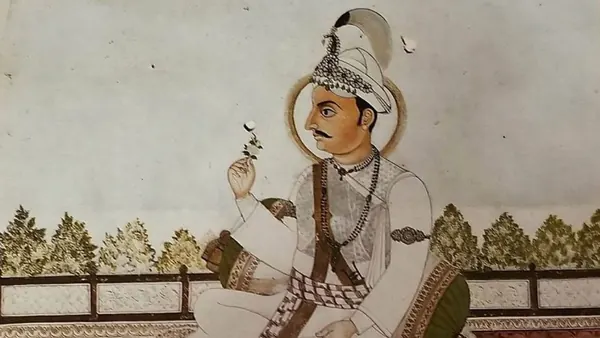
Prithvi Narayan Shah, king of the small hill state of Gorkha, spent more than two decades encircling the Kathmandu Valley before taking it.
Read more
The fortified town of Kirtipur resisted longest, beating back Gorkhali assaults in 1757 and 1764 — his commander Kalu Pande was killed in the first — and falling only at the third attempt after betrayal from within. Later foreign accounts, by the Capuchin priest Giuseppe and by Colonel Kirkpatrick, report that the king then had the noses and lips of the town's men cut off as a warning; the story is widely repeated in Nepal and disputed by some historians, who question these second-hand sources. Kathmandu fell in 1768 and Prithvi Narayan Shah was proclaimed king there on 25 September; Patan submitted soon after and Bhaktapur in 1769. He described the new state as a yam between two boulders, and his campaign is remembered very differently by different communities: as the founding of a unified Nepal, and, particularly among Newars, as a conquest that ended their own kings.
- 17691825/26 BS1769 – 2008
The Shah dynasty
The dynasty founded by Prithvi Narayan Shah reigned over Nepal for 240 years, longer than almost any other in modern Asia.
Read more
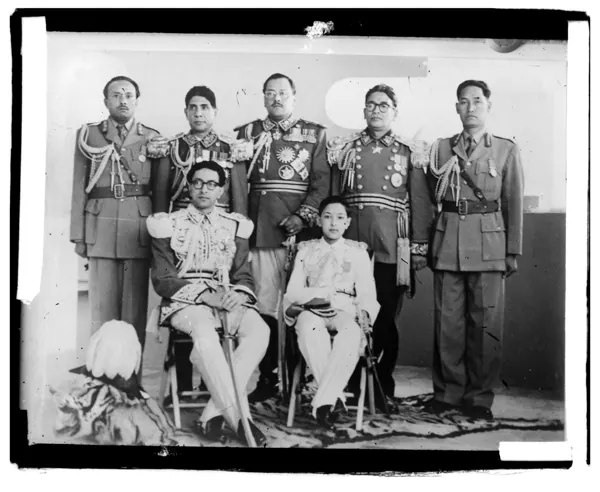
Its early decades saw rapid expansion across the Himalaya, halted by war with Qing China in 1792 and by the East India Company in 1816. From 1846 the Shah kings were reduced to figureheads under the hereditary Rana prime ministers, regaining real power only in 1951. King Mahendra dismissed the elected government in 1960 and ruled through the partyless Panchayat system; King Birendra accepted a constitutional role after the 1990 People's Movement. The dynasty's last years were catastrophic: the palace massacre of 2001, King Gyanendra's seizure of direct power in 2005, and the mass protests that followed. The Constituent Assembly abolished the monarchy on 28 May 2008. Nepalis remain divided about the Shah legacy, and monarchist sentiment has not disappeared — but the institution itself ended by a vote of 560 to 4.
- 17881844/45 BS1788 – 1792
War with Tibet and Qing China
Disputes over debased coinage, trade and salt, and over Nepal's sheltering of a Tibetan lama, led Nepal to send forces across the Himalaya in 1788.
Read more
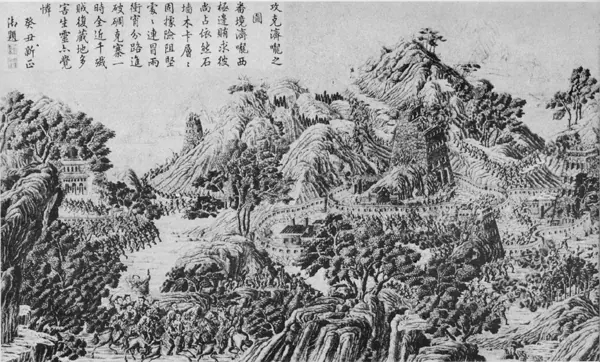
Gorkhali troops occupied territory around Kuti and Kerung, and a settlement in 1789 required Tibet to pay Nepal an annual sum. When payment stopped, Nepal attacked again in 1791, reaching Shigatse and looting the Tashilhunpo monastery. Tibet appealed to its Qing overlords, and in 1792 the Qianlong emperor sent a large army under the general Fuk'anggan, which drove the Nepali forces back over the passes and advanced towards Kathmandu before being checked near the Betrawati river. The Treaty of Betrawati closed the war in October 1792: Nepal returned its loot, accepted a formal tributary relationship with the Qing court involving missions every five years, and gained trading rights. The war ended Nepal's northward expansion and turned its ambitions west and south — towards a collision with the British.
- 18141871 BS1814 – 1816
The Anglo-Nepalese War
Nepal's expansion along the Himalaya and into the Terai brought it into conflict with the East India Company, which declared war on 1 November 1814. British columns advanced on several fronts and fared badly at first.
Read more
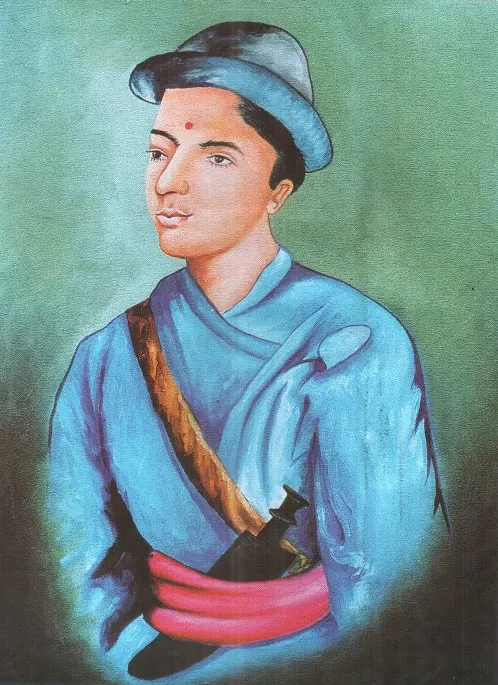
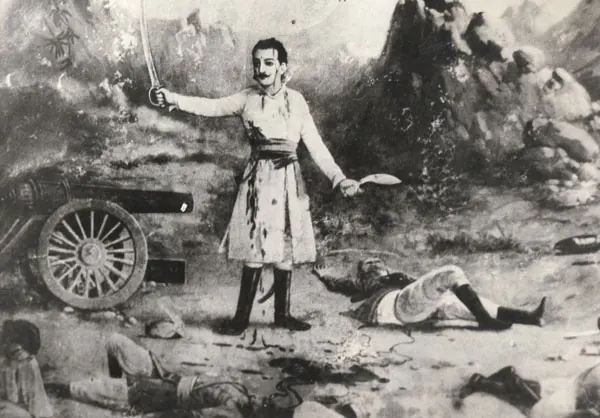
At Nalapani, near Dehradun, a garrison of about six hundred under Balbhadra Kunwar held out for a month against far larger forces, killing Major-General Rollo Gillespie, before breaking out; the fighting at Jaithak was similarly costly. In the west, Major-General David Ochterlony's methodical campaign eventually broke Nepali resistance. The veteran commander Bhakti Thapa was killed at Deuthal, and Amar Singh Thapa surrendered on terms in May 1815. A second campaign reached Makwanpur, close to Kathmandu, and forced Nepal to terms. Both sides emerged with lasting respect for the other's soldiers — a respect that would shape the next two hundred years of Nepal's relationship with Britain.
- 18151871/72 BS1815
The first Gurkha battalions in British service
The war left British officers deeply impressed by the soldiers they had fought.
Read more
During the campaign, Ochterlony and the political agent William Fraser recruited Nepali and hill soldiers — many of them deserters or men released after surrenders — into irregular units. In 1815 three battalions were raised that became the ancestors of the British Gurkha regiments: the Nasiri battalion, the Sirmoor battalion raised by Fraser and Lieutenant Frederick Young, and the Kumaon battalion, later the 1st, 2nd and 3rd Gurkha Rifles. The Treaty of Sugauli did not itself create a recruitment system and Nepal's rulers were at first reluctant; regular, officially sanctioned recruitment developed only over the following decades. From these beginnings grew a military relationship lasting more than two centuries, taking Nepali soldiers to the two world wars, Malaya, Borneo, Hong Kong, the Falklands and Afghanistan — and eventually bringing Gurkha families and veterans to settle in Britain.
- 18161872 BS4 March 1816
The Treaty of Sugauli
The treaty that ended the Anglo-Nepalese War was signed at Sugauli in December 1815 and ratified on 4 March 1816.
Read more
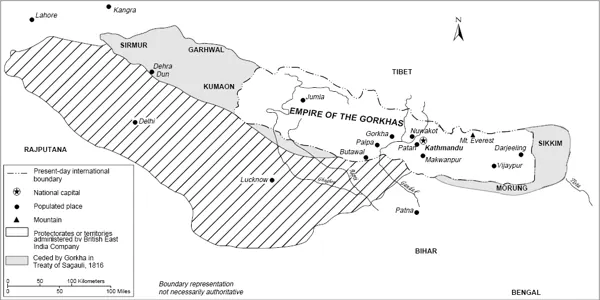
Nepal ceded roughly a third of its territory: Sikkim, most of the lands west of the Mahakali river including Kumaon and Garhwal, and large parts of the Terai, though some Terai land was returned in 1860 in recognition of Nepali help during the Indian rebellion. Nepal also accepted a British Resident in Kathmandu, an intrusion the court resented and worked hard to limit. The treaty fixed Nepal's modern boundaries and, with them, arguments that have never quite closed — most visibly over Kalapani, Lipulekh and Limpiyadhura in the far north-west, where Nepal and India read the treaty's description of the Mahakali's source differently. Nepal was never colonised, and the treaty is often cited as evidence of that; it also marked the end of its expansion and the beginning of a long, careful accommodation with British power.
- 18461903 BS1846 – 1951
The Kot massacre and a century of Rana rule
On the night of 14 September 1846, after the murder of General Gagan Singh Bhandari, Queen Rajya Lakshmi Devi summoned the court to the Kot, an armoury courtyard beside the palace, and demanded the culprits be named.
Read more
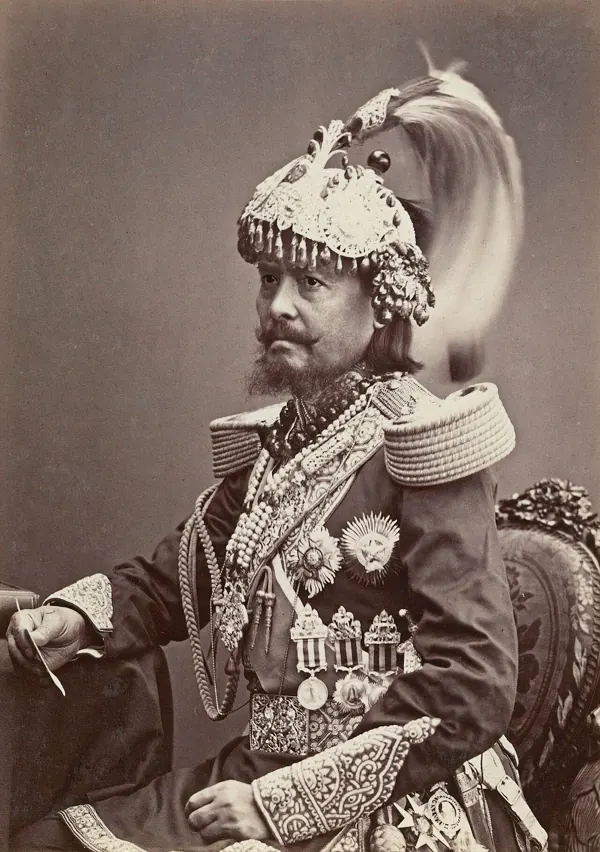
Accounts differ, but fighting broke out and dozens of nobles were killed, among them the prime minister Fateh Jung Shah. Jung Bahadur Kunwar, who commanded troops at the scene, emerged in control, became prime minister within days, took the title Rana and secured hereditary powers that reduced the Shah kings to figureheads for the next 104 years. Historians disagree over how far the killings were planned and by whom. Under the Ranas Nepal stayed independent but largely closed: little schooling, almost no roads or industry, no political parties and no press, alongside enormous palaces built in Kathmandu. Their rule ended in 1951. The period is remembered for that isolation, and for the diplomatic achievements — the 1923 treaty, the abolition of slavery — that came with it.
- 19141970/71 BS1914 – 1945
Nepal in the two world wars
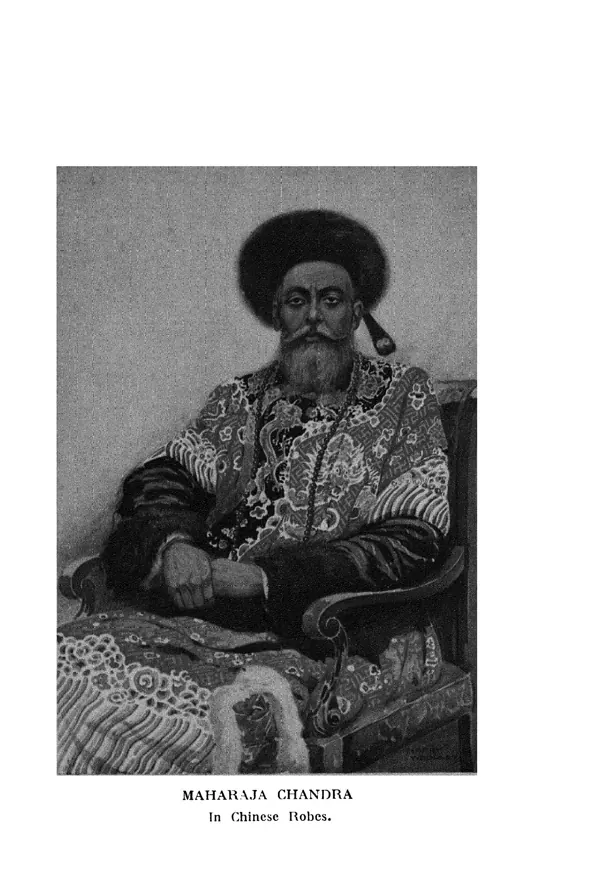
When war broke out in 1914 the prime minister Chandra Shumsher placed Nepal's resources at Britain's disposal.
Read more
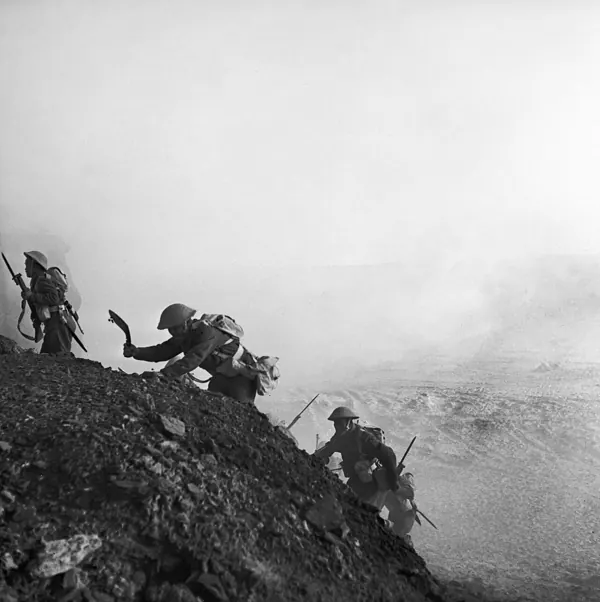
Recruitment into the Gurkha regiments expanded enormously and Nepal sent troops of its own army to India to release units for service abroad. Estimates put the number of Nepalis who served in the First World War at around two hundred thousand, fighting in France, Gallipoli, Mesopotamia, Palestine and on the North-West Frontier, with roughly twenty thousand killed and wounded. Nepal declared war on Germany on 4 September 1939, the day after Britain, and the pattern repeated on a larger scale: around a quarter of a million Nepalis served in the Second World War, in North Africa, Italy, Greece, Syria, Malaya, Singapore and above all Burma, with casualties usually put near thirty-two thousand and more than two and a half thousand awards for gallantry. The losses were felt across the hill districts, and the money, pensions and experience the survivors brought home reshaped village economies and, in time, Nepali politics.
- 19231980 BS21 December 1923
Britain formally recognises Nepal's independence
Signed in Kathmandu on 21 December 1923 by the prime minister Chandra Shumsher and the British envoy Lieutenant-Colonel William Frederick O'Connor, the Treaty of Perpetual Peace and Friendship replaced the arrangements that had governed relations since Sugauli.
Read more
Its first article recorded mutual recognition of each state's independence, internal and external, and undertook that each would respect the other's sovereignty. It also allowed Nepal to import arms and munitions through British India for its own defence, and exempted Nepali government goods from Indian customs duties. The treaty was registered with the League of Nations in 1925. Nepal had never been annexed or made a protectorate, but the treaty put its status beyond argument at a time when almost every neighbour was under colonial rule, and it is generally regarded as the principal diplomatic achievement of the Rana period. It also confirmed the continued recruitment of Nepali soldiers into British service.
- 19241981 BS1924 – 1925
The abolition of slavery
On 28 November 1924 Chandra Shumsher delivered a long public address setting out the case for ending slavery in Nepal, and emancipation was carried through over the following months, taking effect in 1925.
Read more
Slavery had existed in several forms, and earlier restrictions — a ban on enslaving Brahmins and Chhetris in 1803, further measures in 1839 — had had limited effect. Under the new arrangements owners were compensated from state and temple funds rather than the freed people receiving reparation, and contemporary British press reports put the number emancipated at between fifty and sixty thousand. The reform was widely praised abroad and did a great deal for the regime's international reputation. Its effects at home were more limited: freed families often lacked land or capital, and other forms of bonded and unfree labour, notably the kamaiya and haliya systems, persisted for decades. Kamaiya bonded labour was formally abolished only in 2000, and haliya in 2008.
- 19341990 BS15 January 1934
The Nepal–Bihar earthquake
Shortly after two o'clock in the afternoon of 15 January 1934, an earthquake of about magnitude 8 struck the eastern Himalaya, with its epicentre in eastern Nepal south of Mount Everest.
Read more
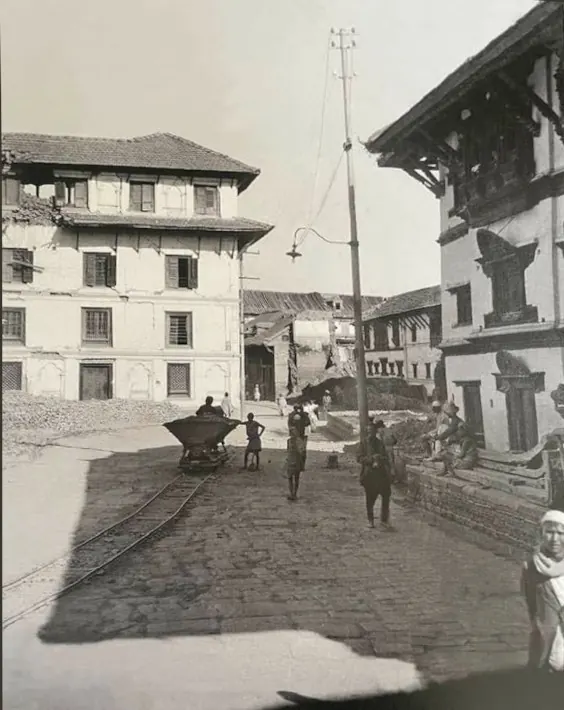
It remains one of the most destructive earthquakes recorded in South Asia. Estimates of the dead range from about ten to twelve thousand across Nepal and the Indian province of Bihar, where more than seven thousand deaths were recorded. In the Kathmandu Valley the damage was severe: a large proportion of buildings in Kathmandu, Patan and Bhaktapur were destroyed or badly damaged, including temples and palace structures, and fields and roads were split by ground cracking and liquefaction. Reconstruction under the Rana prime minister Juddha Shumsher reshaped parts of Kathmandu, with new streets and buildings replacing older fabric; the Dharahara tower that fell in 2015 dated from this rebuilding. In Bihar the disaster drew national attention in India, and relief work there involved Gandhi and other Congress leaders.
- 19411997 BSJanuary 1941
The four martyrs
Organised opposition to Rana rule took shape in the 1930s with the Nepal Praja Parishad, founded around 1936 by Tanka Prasad Acharya, Dasharath Chand, Dharma Bhakta Mathema, Ganga Lal Shrestha and others.
Read more
Parties, meetings and a free press were banned, so the group worked in secret, circulating handwritten leaflets and making contact with the exiled king Tribhuvan. In 1940 the network was betrayed and its members arrested. Death sentences followed in January 1941. Shukraraj Shastri, a scholar already imprisoned for his teaching, was hanged at Pachali in Teku on 24 January; Dharma Bhakta Mathema, a wrestler who had trained the young king, was hanged days later; Ganga Lal Shrestha and Dasharath Chand were shot beside the Bishnumati at Shobha Bhagwati on 28 January. Acharya's sentence was commuted to life imprisonment because his caste protected him from execution under the law of the time. The four are commemorated each year on Martyrs' Day, and the executions hardened the opposition rather than ending it.
- 19472003 BS1947 – 1949
Parties form in exile; workers strike at Biratnagar
Nepali exiles in India, many influenced by the independence movement there, formed the Nepali National Congress in Calcutta in January 1947 under B. P.
Read more
Koirala, with Tanka Prasad Acharya elected president in absentia while imprisoned in Nepal. Within weeks the new party was drawn into the first large industrial action in Nepal's history, a strike at the jute mills of Biratnagar that began in March 1947 over pay and conditions and broadened into a demand for civil liberties. The government sent troops and marched the leaders, Koirala among them, to Kathmandu. In 1950 the party merged with Subarna Shamsher Rana's Nepal Democratic Congress to form the Nepali Congress. On 15 September 1949 a small group in Calcutta announced the Communist Party of Nepal under Pushpa Lal Shrestha, deliberately choosing the anniversary of Jung Bahadur's seizure of power. The two traditions founded in these three years have dominated Nepali politics ever since.
Nepal, explained for Nepalis abroad. The week's news from Nepal, plus guides on citizenship, passports and land, free every Friday.
Subscribe free