

The Malla era
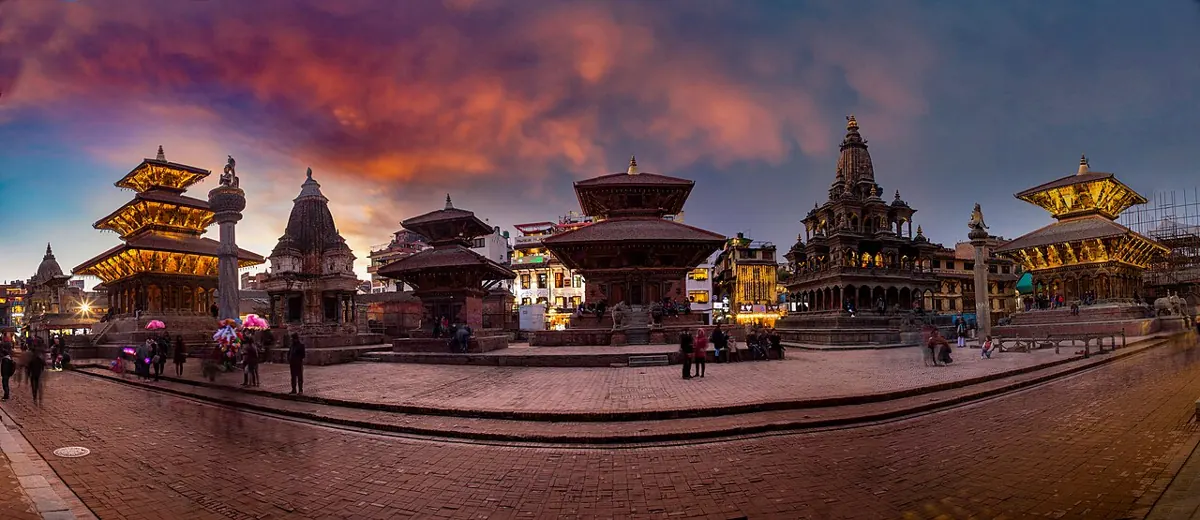
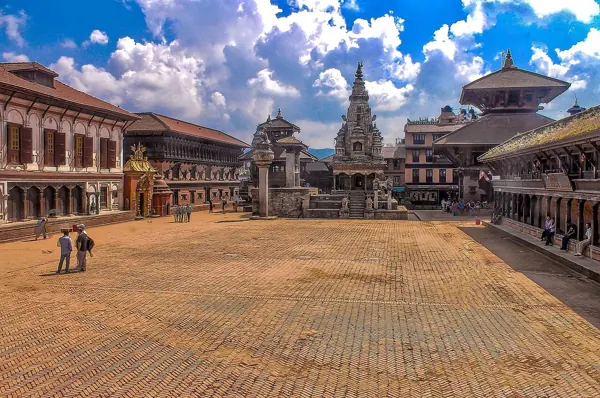
Patan Durbar Square at dusk: the palace square of the Malla kings of Lalitpur. Image: Wikimedia Commons, Mithunkunwar9, CC BY-SA 4.0
For more than five centuries the Malla kings ruled the Kathmandu Valley, from 1482 as three rival kingdoms: Kantipur (Kathmandu), Lalitpur (Patan) and Bhaktapur. Nepal Bhasa was the language of their courts and Nepal Sambat their calendar, and much of what the world now knows as Nepal's heritage was built or rebuilt in these centuries: the three Durbar Squares, the Nyatapola and the Krishna Mandir, the house of the living goddess, and a literature of poetry and drama.
- 11 events
- 1201 – 1769
- The whole timeline
The Malla era
For more than five centuries the Malla kings ruled the Kathmandu Valley, from 1482 as three rival kingdoms: Kantipur (Kathmandu), Lalitpur (Patan) and Bhaktapur. Nepal Bhasa was the language of their courts and Nepal Sambat their calendar, and much of what the world now knows as Nepal's heritage was built or rebuilt in these centuries: the three Durbar Squares, the Nyatapola and the Krishna Mandir, the house of the living goddess, and a literature of poetry and drama.
- 12011201 – 1769
The Malla golden age
The Malla kings ruled the Kathmandu Valley for more than five centuries, and the period is generally regarded as the golden age of Nepali art and architecture.
Read more
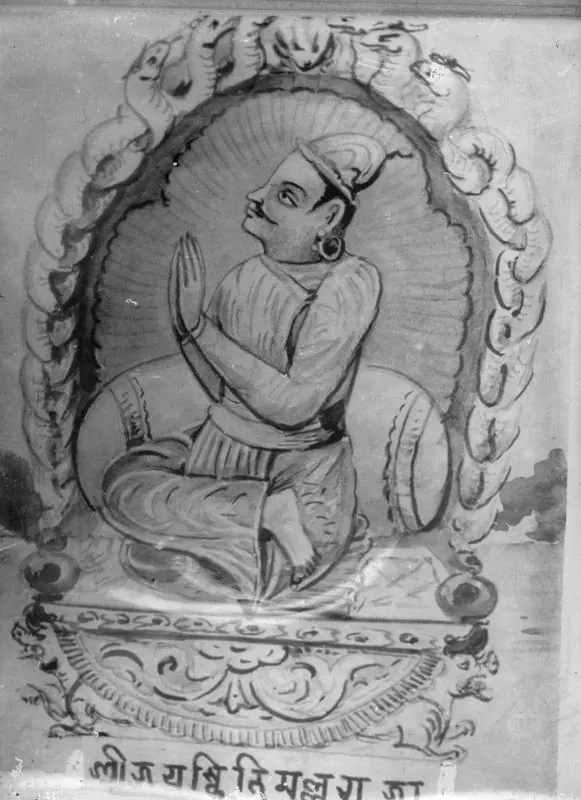
Jayasthiti Malla, proclaimed king in 1382, is credited by the chronicles with codifying law, standardising weights and measures, and arranging the population into ranked hereditary occupational groups — the formal ordering of caste among the Newars, whose social effects were long-lasting and are still debated. After the death of his grandson Yaksha Malla around 1482 the kingdom divided, and by the early sixteenth century three rival courts were settled at Kathmandu, Lalitpur and Bhaktapur. Their competition for trade and prestige funded an extraordinary period of building: the palace complexes and temple squares of the three durbar squares, now World Heritage sites, date largely from this rivalry. It also left the valley politically fragmented, a weakness that proved decisive when the Gorkha kingdom advanced in the eighteenth century.
- 12451245 – 1306
Araniko carries Newar art to China
Araniko, also written Aniko or Anige, was born in the Kathmandu Valley during the reign of Abhaya Malla and became one of the most consequential artists in Asian history.
Read more
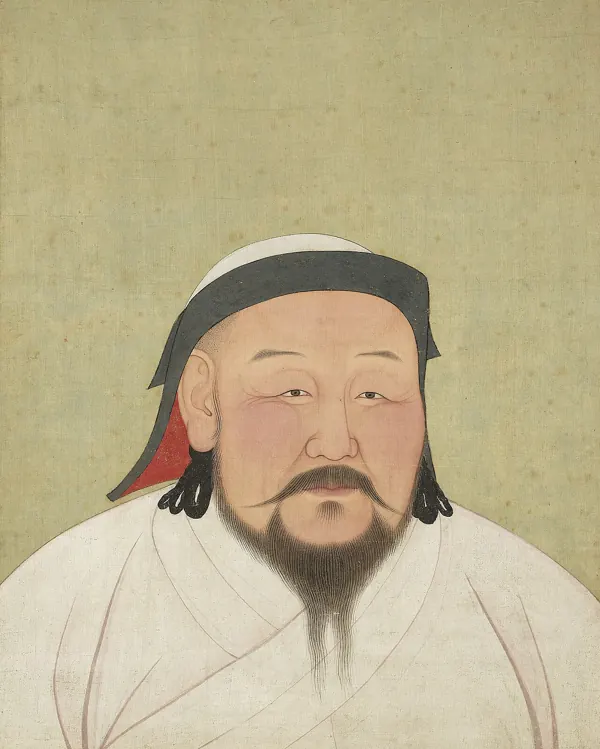
Sent as a young man to Tibet to build a golden stupa, he was ordained a monk there, and was then sent on to the court of Kublai Khan, founder of the Yuan dynasty. He led a team of eighty artists and craftsmen and spent the rest of his life in China, rising to senior office in the imperial workshops. His best-known work is the White Stupa at the Miaoying Temple in Beijing, still standing today. Through him the trans-Himalayan artistic tradition of the Newars reached the Chinese court and shaped Yuan religious art and architecture. He later renounced monkhood and raised a family. In Nepal he is remembered as evidence of how far the valley's craftsmanship travelled, and the highway linking Kathmandu to the Tibetan border is named after him.
- 12551255
A great earthquake kills King Abhaya Malla
On 7 June 1255 a major earthquake struck the Kathmandu Valley.
Read more
The Nepali chronicles say it killed more than a third of the valley's people, and that King Abhaya Malla, who had reigned since about 1216, was injured and died some six days later. His son Jayadeva Malla succeeded him.
The reign had already been unsettled: rebels had attacked Kirtipur and part of Bhaktapur in 1242, and an army from Tirhut reached Gokarna in 1245. The chronicles give no detailed toll, and the figure of a third is a general estimate rather than a count.
Modern geology has backed the chronicle record. A 2012 study by researchers from Nepal, France and Singapore, published in Nature Geoscience, used carbon dating of displaced river sediments to link a surface-rupturing earthquake in eastern Nepal to the great quake of 1255. Most accounts give the date as 7 June; a press report of the study gave 7 July.
- 1349c. 1349
The Sultan of Bengal's army sacks Swayambhu
In the mid-fourteenth century an army sent by Shamsuddin Ilyas Shah, Sultan of Bengal, entered the Kathmandu Valley, the first Muslim force recorded there.
Read more
The historian Baburam Acharya dated the raid to 1349 or 1349/50, beginning on the 21st of Marga (November or December); other accounts give 1346.
An inscription at Swayambhu records that the stupa was looted, and the same record is cited for severe damage to the Pashupatinath temple. Acharya wrote that the invaders burned houses and chaityas in Kathmandu after finding the people gone, and attacked Bhaktapur. No death toll is known.
The valley was politically divided at the time. The army withdrew after a short stay, and neither Nepali nor Bengali records explain why.
- 1382c. 1382 – 1395
Jayasthiti Malla brings the valley under one rule
Jayasthiti Malla ruled the Kathmandu Valley from about 1382 until his death in 1395, after decades in which it had been divided among rival lords.
Read more
He rose through his marriage to Rajalladevi, heir of the Bhaktapur royal house, through alliances with nobles, and through victories over rivals in 1372 and 1374. He sent the reigning king, Jayarjuna, into exile at Banepa in November 1381 and was proclaimed king in September 1382. His three sons ruled jointly after him.
He is remembered above all for a social code. The chronicles credit him with fixing occupations and ranks by caste across the valley's communities, assigning priestly and administrative roles, crafts and trades, and with reforms to punishment under which fines replaced beatings. Historians debate how much of this was new and how much codified existing practice, but the order it describes shaped Newar society for centuries.
His control was never complete: during his reign the Bhontas declared independence and the lords of Patan pressed for autonomy.
- 1428c. 1428 – 1482
Yaksha Malla's reign, and the valley splits into three
Yaksha Malla ruled from Bhaktapur from about 1428 until his death in 1482, the last king to rule the whole valley.
Read more
The chronicles credit him with raids south into Mithila and Bihar, with control of the trade route to Tibet, and with taking the Tibetan stronghold of Shelkar Dzong. In Bhaktapur he is said to have ringed the city with walls and moats, built a copy of the Pashupatinath temple and created the Siddha Pokhari tank. A copperplate of 1446 belongs to his reign, and the Mul Chok of the Bhaktapur palace is dated 1455.
After his death the kingdom was divided among his sons. Raya Malla held Bhaktapur and Ratna Malla Kantipur (Kathmandu); Lalitpur (Patan) became a third kingdom, and a fourth at Banepa was soon absorbed by Bhaktapur. For the next three centuries Bhaktapur (Khwopa), Kantipur (Yen) and Lalitpur (Yala) were rivals, often at war, and competed in building their palace squares.
- 16331633 (Malla era)
Nepal Bhasa, the language of the Malla courts
Nepal Bhasa, the Newar language, was the court and literary language of the Malla kingdoms, and Nepal Sambat their official calendar, used on coins, inscriptions and royal decrees.
Read more
The earliest dated palm-leaf manuscript in the language, from Uku Baha in Patan, is dated Nepal Sambat 234, or 1114.
Under Jayasthiti Malla in the fourteenth century, Sanskrit classics were first translated into Nepal Bhasa, and the Gopal Raj Vamshavali, a chronicle of the valley's kings, dates from the same period. Drama flourished later at all three courts: Siddhi Narasimha Malla of Patan wrote the Ekadashivrata in 1633, described as the first Newar drama, and Jaya Prakash Malla and Ranajit Malla of Bhaktapur were known as playwrights. Jagat Prakasha Malla compiled 519 poems in the Nepalabhashaya Gita.
After the Gorkha conquest the language lost its official standing to Gorkhali, the forerunner of today's Nepali, and the Shaka calendar replaced Nepal Sambat in official use. Nepal Bhasa was still used in the Nepal–Tibet treaty of 1775, and in 2011 the government decided to adopt Nepal Sambat as a national calendar.
- 16371637
The Krishna Mandir rises in Patan
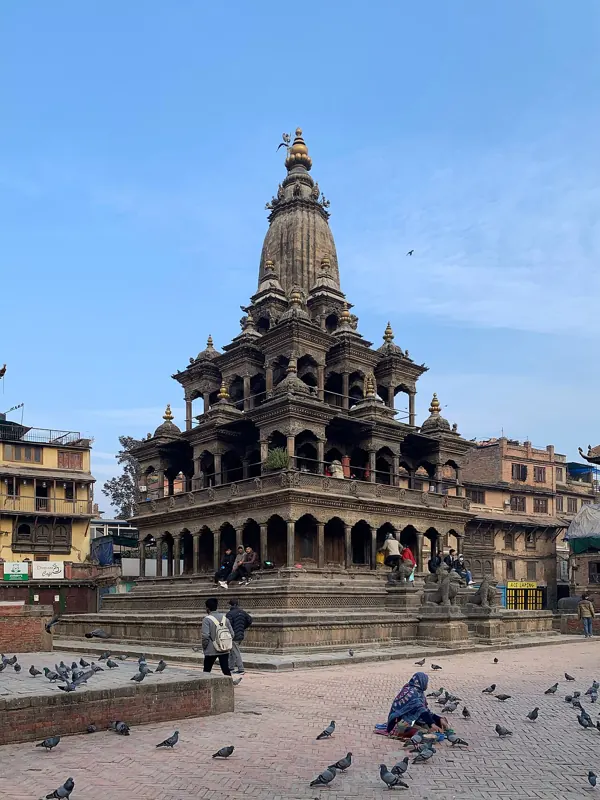
The Krishna Mandir, the stone temple that dominates Patan Durbar Square, is usually dated to 1637 and credited to King Siddhi Narasimha Malla of Lalitpur, who reigned from 1620 to 1661.
Read more
Some accounts give 1667; 1637 is the date most widely cited.
It is built in the shikhara style rather than the valley's tiered pagoda form: three storeys beneath twenty-one pinnacles, with statues of Vishnu on Garuda around the base of the main tower. Friezes along the beams of the first and second floors show scenes from the Mahabharata and the Ramayana, captioned in Newar script.
Tradition says the king dreamed of Krishna and Radha standing before the palace and ordered a temple built on that spot. The same king is credited with the Vishwanath temple of 1627 and the original Taleju temple of 1640 in the same square. The Krishna Mandir was damaged in the 2015 earthquake and restored by 2018, and it remains the centre of the Krishna Janmashtami celebrations in Patan.
- 16541654
Pratap Malla's inscription in fifteen scripts
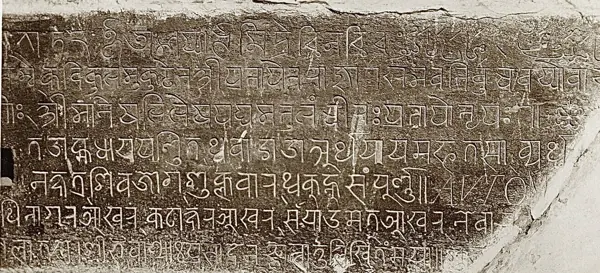
In Kathmandu Durbar Square stands a stone inscription dated Nepal Sambat 774, or 1654, set up by King Pratap Malla of Kantipur, who ruled from 1641 to 1674.
Read more
It is an invocation to the goddess Kalika written in fifteen scripts, and in it the king says that he composed verses in fifteen scripts; some descriptions count fourteen. The stone served as a water spout, and a local saying holds that milk would flow from it if anyone could read every script.
Pratap Malla styled himself Kavindra, king of poets. He is credited with 138 poems in Nepal Bhasa, about forty of which survive, and with Sanskrit hymns in temple inscriptions. His coins carried his name in Newar script, and Kantipur profited from minting coins for Tibet. He tried and failed to bring all three kingdoms under his rule, but built widely in Kathmandu, including the Rani Pokhari pond (1669 or 1670), built to console his queen after the death of their son.
- 17021758/59 BS1702
The Nyatapola, Nepal's tallest temple, in Bhaktapur
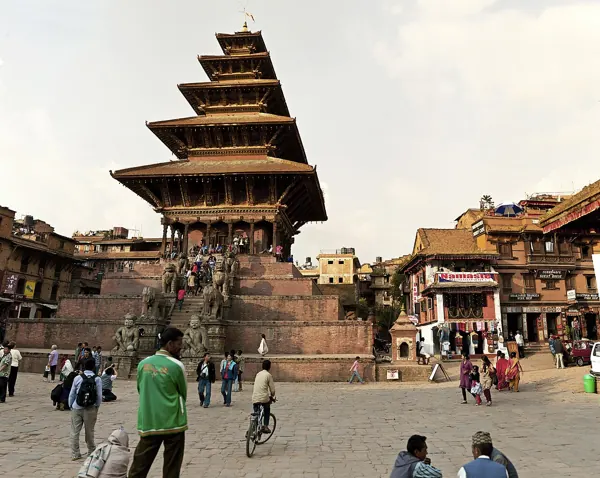
The Nyatapola, a five-storey pagoda on Taumadhi Square in Bhaktapur, was completed in 1702 on the orders of King Bhupatindra Malla, who reigned from 1696 to 1722.
Read more
At about 30 metres it is the tallest temple in the valley and one of only two of five storeys, the other being the Kumbheshwar temple in Patan. Accounts of the building time differ, but all describe it as remarkably fast, a matter of months.
Five pairs of stone guardians line its stairway: wrestlers at the bottom, then elephants, lions, sardulas (mythical lion-like beasts) and, at the top, the goddesses Simhini and Vyaghrini, each pair said to be ten times stronger than the one below.
The temple came through the earthquakes of 1934 and 2015 that badly damaged the rest of Bhaktapur, and is often cited as evidence of the skill of Malla-era builders. Bhupatindra Malla also completed the remodelled Palace of Fifty-five Windows in 1708, and his play Gaurivivaha, in Nepal Bhasa, was staged in Patan in 1707.
- 17571813/14 BS1757
Jaya Prakash Malla builds the Kumari Ghar
The Kumari Ghar, the house of the living goddess in Kathmandu Durbar Square, was built in 1757 (1813 BS) by King Jaya Prakash Malla.
Read more
It is a three-storey Newar building around a courtyard, with a carved wooden toran over the entrance and a stone chaitya in the courtyard.
The Kumari tradition is older than the house. It is first recorded in an inscription of 1280, under Ananta Malla, and some chronicles credit Trailokya Malla, in the late sixteenth century, with formalising it. The Kumari is chosen from girls of the Shakya and Bajracharya families of the Newar community; Jaya Prakash Malla is said to have begun the Kumari's chariot procession at Indra Jatra in 1756.
A popular legend links the custom to the king himself: the goddess Taleju played dice with him each night on condition that he tell no one, vanished when his daughter followed him, and later told him in a dream to seek her in a young Shakya girl. It is a story, not a record. Jaya Prakash Malla was the last Malla king of Kathmandu; he lost the city to Prithvi Narayan Shah during Indra Jatra in 1768.


Nepal, explained for Nepalis abroad. The week's news from Nepal, plus guides on citizenship, passports and land, free every Friday.
Subscribe free