

1757 · 1813/14 BS
Jaya Prakash Malla builds the Kumari Ghar
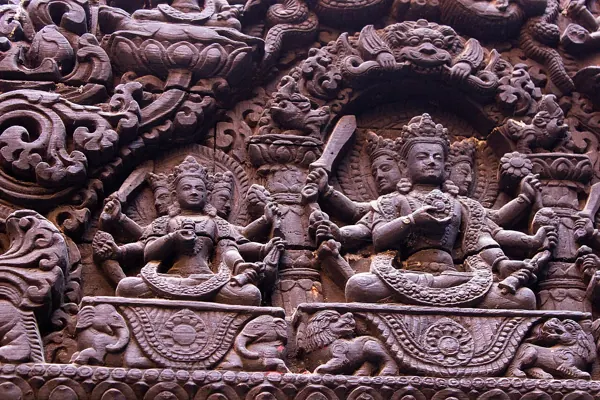
The Kumari Ghar, the house of the living goddess in Kathmandu Durbar Square, was built in 1757 (1813 BS) by King Jaya Prakash Malla. It is a three-storey Newar building around a courtyard, with a carved wooden toran over the entrance and a stone chaitya in the courtyard.
The Kumari tradition is older than the house. It is first recorded in an inscription of 1280, under Ananta Malla, and some chronicles credit Trailokya Malla, in the late sixteenth century, with formalising it. The Kumari is chosen from girls of the Shakya and Bajracharya families of the Newar community; Jaya Prakash Malla is said to have begun the Kumari's chariot procession at Indra Jatra in 1756.
A popular legend links the custom to the king himself: the goddess Taleju played dice with him each night on condition that he tell no one, vanished when his daughter followed him, and later told him in a dream to seek her in a young Shakya girl. It is a story, not a record. Jaya Prakash Malla was the last Malla king of Kathmandu; he lost the city to Prithvi Narayan Shah during Indra Jatra in 1768.
Source and further reading: nepaltraveller.com
Part of A Timeline of Nepal · The Malla era · all events in this era. Last checked 2026-11-19.